
World Models, Not LLMs, Will Power Digital Twins
Separating what LLMs do best from what world models must do inside next‑generation industrial digital twins

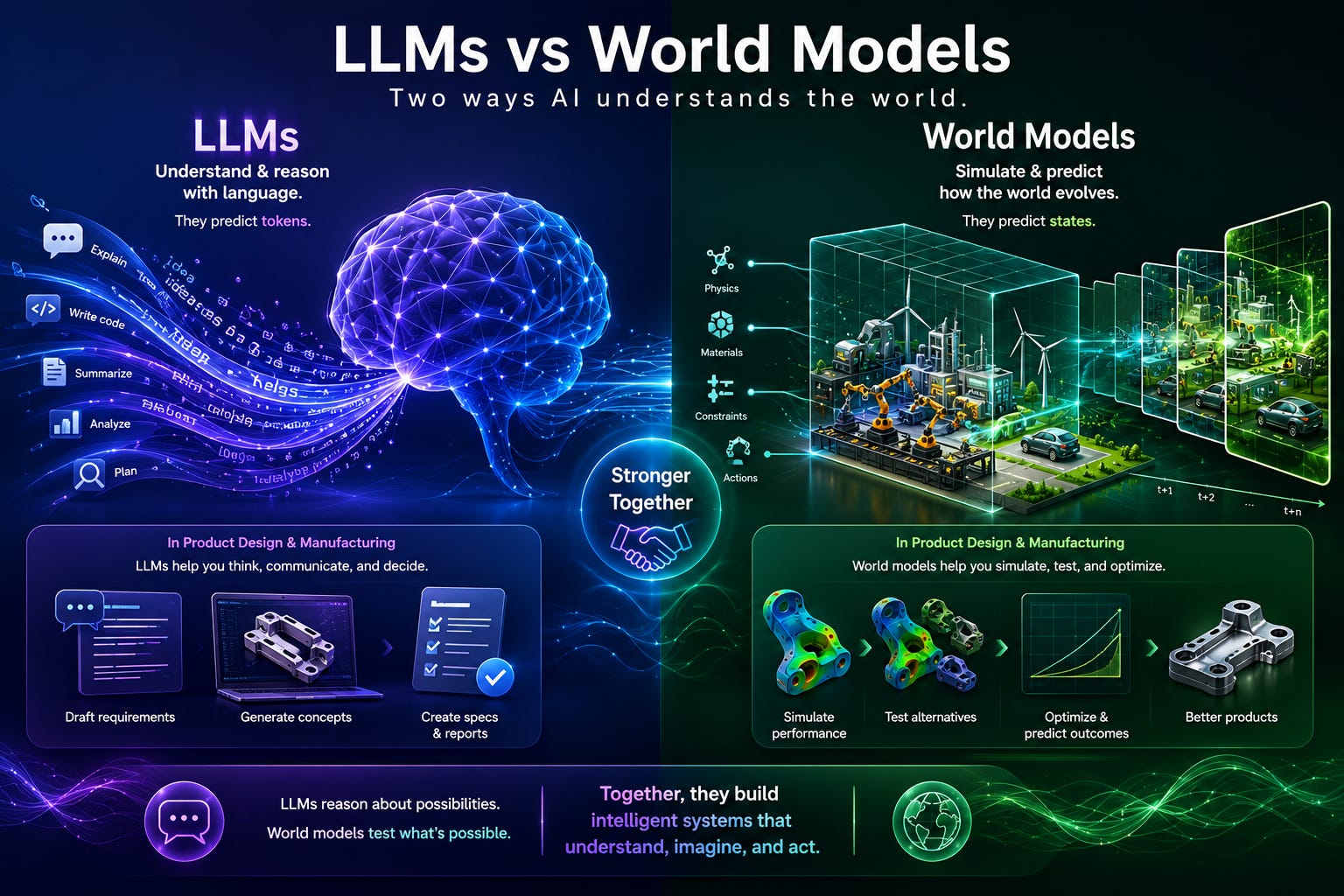
I wanted to look down the road on what is coming next and what research organizations are looking at.
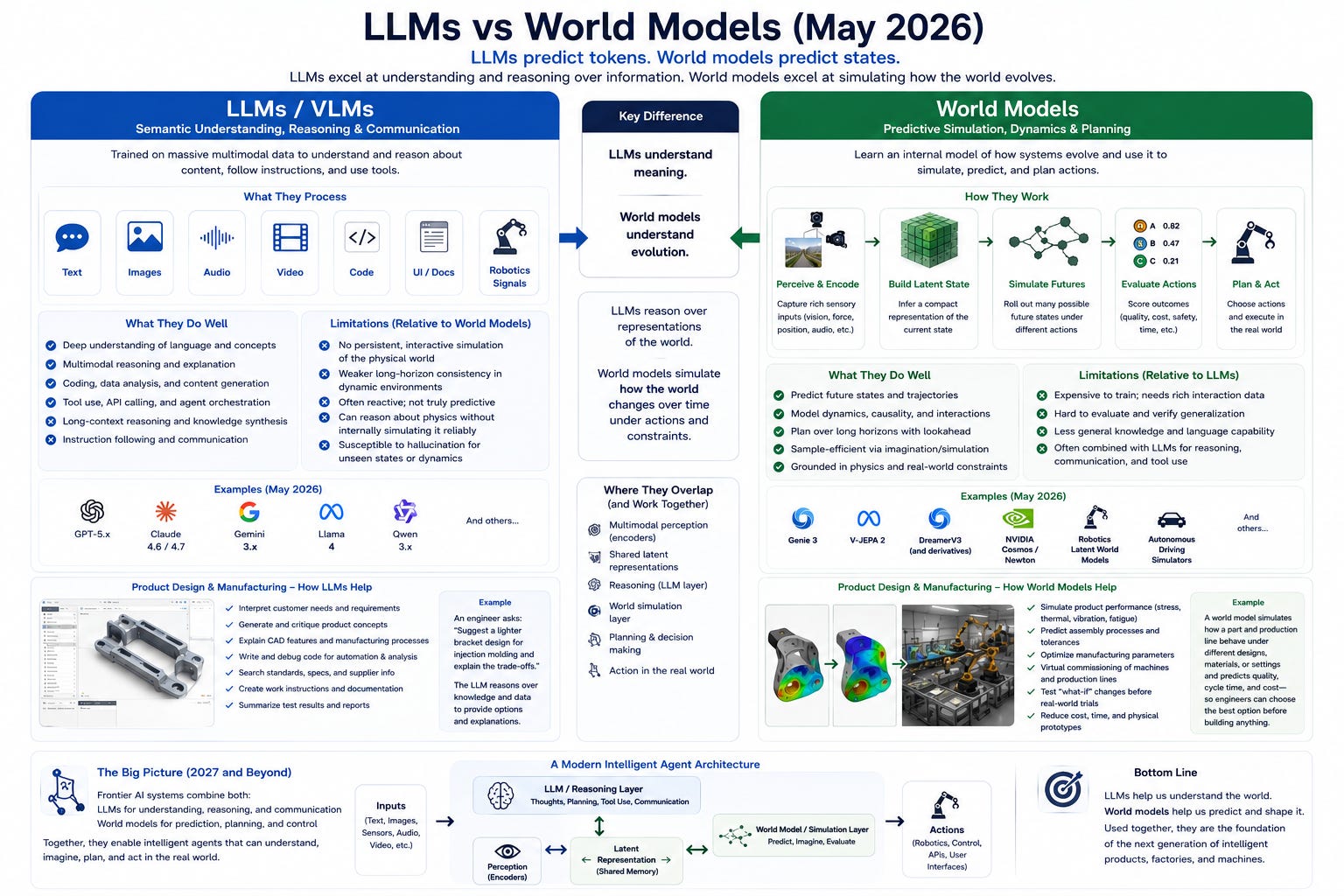
In 2027, we can expect two AI paradigms to crystallizing around different layers of the manufacturing stack: large language models (LLMs) are becoming the interface and orchestration layer for product knowledge and workflows, while world models are emerging as the prediction engines inside digital twins and “industry world models.” For manufacturing leaders, the key architectural insight is that LLMs will largely manage and manipulate models, whereas world models will increasingly be the models of dynamics that digital twins rely on to forecast what happens next. [web:2] [web:22] [web:119] [web:113]
1. Why LLMs Are a Natural Fit for PLM Workflows
In 2026, LLMs are becoming deeply embedded in engineering and product lifecycle management (PLM) workflows, not because they “understand physics,” but because they excel at reading, writing, and transforming the artifacts that define products and processes: requirements, CAD metadata, simulation reports, test logs, and change orders. [web:22] [web:92]
Analysts tracking digital-twin platforms note that a major bottleneck is still model authoring—turning drawings, BOMs, and sensor data into usable twin models—and highlight generative AI and LLMs as the most likely disruptors for automating twin construction and documentation. PatSnap’s 2026 digital-twin landscape report explicitly calls out large language models and generative design tools as catalysts that can “automate twin model construction from engineering drawings and sensor data, drastically reducing setup time and specialist labor.” [web:22]
Research on continuously updated digital twins (e.g., CALM-DT) demonstrates practical patterns where an LLM sits on top of a twin and related logs, interpreting new data, updating parameters, and restructuring the model as designs, regulations, or operating conditions change. These systems treat the LLM as a reasoning and authoring layer that can translate between human language, historical telemetry, and the underlying model schema. [web:84]
Taken together, the emerging consensus in industry reports and academic work is that LLMs are best viewed as the “semantic operating system” for engineering data and workflows: they summarize design histories, generate documentation, parse standards, propose changes, and drive approval workflows across PLM, ALM, and QMS systems. [web:22] [web:92] [web:113]
2. What World Models Are—and Why Prediction Is Their Core
Where LLMs model text sequences, world models model state and dynamics. Nature’s 2026 primer describes world models as AI systems trained on data from physical environments (video, sensor logs, simulations) to learn internal representations of how the world evolves, enabling them to simulate actions and consequences instead of just producing static outputs. [web:74]
Forbes’ 2026 overview puts it in business terms: world models build a conceptual “latent space” in which an AI can explore hypothetical scenarios and strategize consequences, rather than treating inputs as mere lists of words or pixels. In this latent space the system can ask, effectively, “If we do X here, what happens next?”—which is exactly the question digital twins are meant to answer. [web:2]
Yann LeCun’s Joint Embedding Predictive Architecture (JEPA) work provides an explicit formulation: instead of generating every pixel or token, a JEPA-style world model predicts future latent embeddings that encode the causally relevant structure of a scene, while discarding noise that is not predictive for downstream decisions. His group’s 2026 LeWorldModel (LeWM) paper shows a JEPA-based world model that trains stably end-to-end from raw pixels using a simple next-embedding prediction loss plus a Gaussian regularizer, explicitly characterizing it as a compact world model for control and planning. [web:116] [web:121]
Commentary on LeWorldModel and AMI Labs emphasizes LeCun’s broader thesis: intelligence requires models that can predict in a simplified space, focusing on objects and interactions rather than raw sensory detail, and using those predictions to guide actions. In other words, the core competency of a world model is not “talking about” the world, but predicting what happens next in a way that is useful for control. [web:100] [web:118] [web:120]
3. Digital Twins in Manufacturing 2026: At the Edge of Prediction
Digital-twin technology in manufacturing has moved from pilot projects to core infrastructure. PatSnap estimates the global digital-twin market at USD 36.19 billion in 2025, projected to reach USD 180.28 billion by 2030, with industrial manufacturing as the dominant application sector. [web:22]
Recent 2026 surveys and vendor reports describe twins spanning component-level models (motors, gearboxes) to factory-scale replicas that simulate material flow, energy consumption, worker movement, and production scheduling. Capabilities now in production include discrete-event simulation, reduced-order modeling, virtual commissioning, predictive maintenance, and quality analytics, often backed by cloud-native platforms such as Azure Digital Twins, AWS IoT TwinMaker, and PTC ThingWorx. [web:22] [web:51] [web:115]
However, even optimistic industry coverage points out that many twins remain “digital shadows”—valuable for monitoring and offline analysis, but not yet closed-loop decision engines. Gartner’s 2026 Manufacturing Predicts report describes a coming inflection toward closed-loop digital twins that ingest real-time data, run optimization or control models, and send prescriptive recommendations—or direct actuation—back to the process, projecting that about 15% of process plants will deploy such systems by 2030. [web:113]
Media and technical outlets covering digital twins in 2026 consistently highlight one emerging pattern: the intelligence layer of twins is being re-architected around AI models that can simulate futures and optimize decisions, not just regress key performance indicators. This is where world models enter the picture. [web:22] [web:92] [web:115]
4. Industry World Models: World Models Inside Twins
The clearest public signal of this shift is the NVIDIA–Dassault Systèmes initiative around “Industry World Models.” Engineering trade press in early 2026 reports that Dassault and NVIDIA are explicitly positioning industry world models as the fusion of virtual twins and accelerated computing, designed to represent industrial systems from components to full factories, and to support reasoning about actions before they are executed. [web:119] [web:67]
These industry world models sit on top of Dassault’s 3DEXPERIENCE and Delmia platforms and NVIDIA Omniverse, combining multi-physics simulation, domain knowledge, and AI. NVIDIA’s own glossary and partner communications describe world models as neural networks that understand the spatial and physical properties of environments, and can generate realistic data or simulate outcomes for robotics, industrial automation, and autonomous systems. [web:1] [web:119]
From a systems-design perspective, this is the critical architectural move: the twin provides the structured geometry, physics engines, and data integration, while the world model is the predictive kernel that runs “what if we do this?” loops at scale, including scenarios far beyond what has been seen historically. Nature’s 2026 article echoes this by noting that world models can become interactive environments for training and testing controllers, particularly for robotics and potentially self-driving vehicles or factory assets. [web:74]
In short, digital twins are becoming the container and context; world models are increasingly the mechanism for prediction and planning inside that container. The more a twin aspires to closed-loop autonomy—including energy optimization, dynamic scheduling, and robotic motion planning—the more it depends on world-model-like capabilities. [web:22] [web:119] [web:113]
5. LLMs and World Models: Different Roles in the Same Loop
Given these trajectories, the slogan “LLMs will run PLM workflows, but digital twins will depend on world models to predict what happens next” captures a real division of labor, but only if it is understood as two roles in a shared loop rather than two disjoint domains. Recent commentary in Forbes, Nature, and industry blogs is converging on the idea that the most capable systems will orchestrate LLMs and world models together, rather than choosing between them. [web:2] [web:74] [web:92]
At a high level, the loop in a manufacturing context looks like this:
LLMs interpret intent and constraints: capturing requirements (“reduce changeover time by 20%”), summarizing standards, and translating informal descriptions from engineers into structured goals and model changes. [web:22] [web:84] [web:92]
LLMs author and edit models: generating or updating twin configurations, simulation scripts, control policies, and documentation, as seen in CALM-DT and vendor announcements about generative twin model construction. [web:22] [web:84]
World models simulate and predict: given a candidate layout, schedule, or control policy, the world model (within or alongside the twin) imagines trajectories under uncertainty, producing forecasts of throughput, energy, downtime, or risk. [web:2] [web:119] [web:74]
LLMs explain and orchestrate actions: summarizing simulation results in human language, comparing alternatives, and triggering changes in PLM, MES, or ERP systems according to governance rules. [web:22] [web:92]
This is fundamentally different from attempting to use an LLM as a crude simulator. Nature’s article explicitly points out that generative models trained purely on text or static data often fail at basic physical reasoning, and that training world models on physical data and simulations is a promising path to overcoming such failures. [web:74]
LeCun’s 2026 commentary and the LeWorldModel work sharpen that argument: a system optimized for predicting future latent state under actions—rather than next token—has the right inductive bias for control and planning, especially in safety-critical domains like robotics and industrial automation. [web:100] [web:116] [web:121]
6. The Manufacturing Stack in 3–5 Years: A Plausible Architecture
Looking three to five years out, current research and vendor roadmaps suggest a manufacturing stack where:
PLM/ALM is LLM-native: LLMs are deeply embedded in PLM, requirements management, and engineering collaboration tools, providing semantic search over design history, impact analysis for changes, code and script generation for simulation, and policy-aware documentation. [web:22] [web:92]
Digital twins are world-model-backed: advanced twins incorporate learned world models that run in real time alongside physics engines, providing fast predictive rollouts for scheduling, energy optimization, and what-if experiments, particularly in closed-loop configurations. [web:22] [web:119] [web:113] [web:115]
Robotics and automation use deployment-grounded world models: work like LeWorldModel and other 2026 JEPA/control research is translated into industrial robot stacks, where models trained on both internet-scale video and plant data forecast task success and long-horizon behavior for manipulators and mobile robots. [web:74] [web:90] [web:116]
Supply-chain simulation uses multi-scale world models: coarse world models simulate demand, sourcing, and logistics; plant twins and cell-level models capture capacity and constraints; agentic planners sit on top, orchestrated partly by LLM-based agents. [web:2] [web:3] [web:37] [web:79]
Critically, none of this eliminates traditional engineering models. Recent 2026 reports on digital twins stress that physics-based simulation, standards compliance, and deterministic control remain non-negotiable in many contexts, especially where certification is required. [web:25] [web:51] World models are best viewed as augmentations that provide richer priors, faster approximate rollouts, and better generalization under distribution shift—not as replacements for first-principles models.
7. Risks, Open Questions, and Research Directions
Despite the excitement, 2026 coverage in Nature, Gartner’s predicts, and multiple industry blogs is careful to emphasize that world models are still early and that manufacturing deployments remain limited. [web:2] [web:74] [web:113] Major open questions include:
Verification and safety: how to validate world-model-backed twins for safety-critical applications (e.g., chemical processes, high-speed machining), and how to quantify uncertainty in their predictions so operators know when not to trust them. [web:74] [web:113] [web:119]
Hybrid physics–ML design: where to draw the boundary between explicit physics engines and learned world models, especially for certification; LeWorldModel and similar JEPA systems show promise for stable training, but industrial-grade verification is still unsolved. [web:25] [web:116] [web:121]
Data governance and IP: how to aggregate enough multi-modal data (video, telemetry, logs) to train powerful world models without compromising trade secrets or regulatory requirements; NVIDIA–Dassault’s AI “factories” are one proposed pattern, using carefully governed cloud infrastructure. [web:119]
Human–AI collaboration: how to design interfaces where engineers can interrogate, override, or refine world-model recommendations, and how to keep mental models aligned with increasingly complex, layered simulations. [web:22] [web:92] [web:113]
For researchers, world models for control and planning (e.g., value-guided JEPA world models and deployment-grounded models like Cortex 2.0) and their integration with industrial twins are fertile areas. [web:99] [web:90] [web:116] [web:79] For practitioners, the more immediate opportunity is to treat LLMs and world models as complementary tools in a phased roadmap: start by using LLMs to tame PLM and twin authoring, then selectively introduce world models as predictive cores where closed-loop autonomy has clear ROI and bounded risk.
8. Conclusion
The dividing line is becoming clear: in manufacturing, LLMs are poised to run PLM and knowledge-heavy workflows—interpreting, generating, and coordinating the information that defines products and processes—while digital twins will increasingly depend on world models to predict what happens next. World models give twins the ability to “rehearse reality” at scale; LLMs give engineers the ability to converse with, configure, and govern those rehearsals. [web:2] [web:22] [web:119] [web:74]
The most interesting factories of the next decade will not be “LLM factories” or “world-model factories” in isolation, but deeply integrated environments where language, physics, and learned dynamics cooperate to design, simulate, and operate complex systems under human oversight.
Key Sources
AI World Models: What Are They And Why Should You Care (Forbes, 2026)
‘World models’ are AI’s latest sensation: what are they and what can they do? (Nature, 2026)
Digital twin tech landscape for manufacturing 2026 (PatSnap)
Digital Twins in 2026: From Digital Replicas to Intelligent AI-Driven Systems (RTInsights)
Digital Twin in Manufacturing 2026: What It Is and Why It Matters (MachineToolNews)
Digital twin is revolutionising manufacturing industry (Taylor & Francis, 2025)
Gartner 2026 Manufacturing Predicts: AI and Digital Twins (Bassetti Group)
Beyond digital twins: NVIDIA and Dassault bet on industry world models (Engineering.com)
Continuously Updating Digital Twins using Large Language Models (CALM-DT, ICML/ICLR)
From Digital Twins to World Models: Opportunities, Challenges, and Future Directions (arXiv, 2026)
LeWorldModel: Stable End-to-End Joint-Embedding Predictive World Models (arXiv, 2026)
Cortex 2.0: Grounding World Models in Real-World Industrial Environments (arXiv, 2026)
Value-guided action planning with JEPA world models (arXiv, 2025)
JEPA & World Models — Yann LeCun’s Bet Against GenAI (Pebblous, 2026)
And yet nobody ever explains who owns the IP when AI/LLM is part of the work. I am excited to see LLM being used in CAD, since I use it every day for my Design work. But I use it to validate my Design and Engineering decisions, but the idea of using inside my CAD package to do this work is not something I can get behind until someone shows me how this LLM work is being done, and especially on who's hardware. The computer industry as a whole has become too intrusive, and I'm not interested in my Design work being used to build their AI LLM library... especially if they're charging me. Furthermore, until CAD vendors only offer a Windows OS platform, I'm not interested, since Microsoft has not proven to be trustworthy when forcing users to use stupid Apps like Recall. Then there's the machine overhead that has slowed my work down because of all the background "services" MS thinks I want or need. I've been using Solid Edge from Siemens for over 30 years, but the moment a CAD Vendor offers a LINUX mid-tier CAD package, I'll be looking at it as serious replacement. Siemens has hitched its wagon to Microsoft, and every release keeps getting slower due to WEB2 services.